
Blue Flower Power: Balance
- Apr 24
- 4 min read
Updated: May 18
Why a meaningful life requires both transcendence and grounding
The balance I want to talk about here is not the type of balance you may be expecting where it’s about optimization or emotional neutrality or finding some work-life balance. That’s not what the Balance in Blue Flower Power means at all.
The default position is always art.

Frank matters. Wonder matters. We need those moments of transendence, those moments when we are totally absorbed and moved. Even overwhelmed sometimes. Because being optimized is fine, but that's not the part of life that you remember.
Dead Poets Society
There’s a great quote in Dead Poet’s Society, where John Keating (Robin Williams) says:
"We don't read and write poetry because it's cute. We read and write poetry because we are members of the human race. And the human race is filled with passion. And medicine, law, business, engineering—these are noble pursuits and necessary to sustain life. But poetry, beauty, romance, love—these are what we stay alive for."
Exactly.

Everyone talks about the poetry part of this quote, but notice that reality matters too. You can't, like Frank, literally fly away forever on a flock of butterflies. Responsibilities matter, relationships matter. The practical world matters and is also “noble.”
So I just want to be clear that balance is not about eliminating the intensity or finding some kind of happy mean between imagination and reality. It's simply about staying connected enough to reality that you retain the ability to really appreciate wonder and not float away entirely.
As I said, the default position is always art. We need that transcendence. We need it to feel alive.
Even the downside. Even heartbreak. There's a reason why people remember heartbreak more than some emotional numbness. Because feeling deeply, even painfully, is still a form of aliveness. It’s better than cutting yourself off and sleepwalking through life.
But modern life makes it tough when everything is about efficiency, productivity, algorithms, metrics, consumption.

And then on the flipside—pure escape. Both destinations are dead ends. You scroll long enough and life gets flat. But you drift too far in the other direction and reality itself disappears.
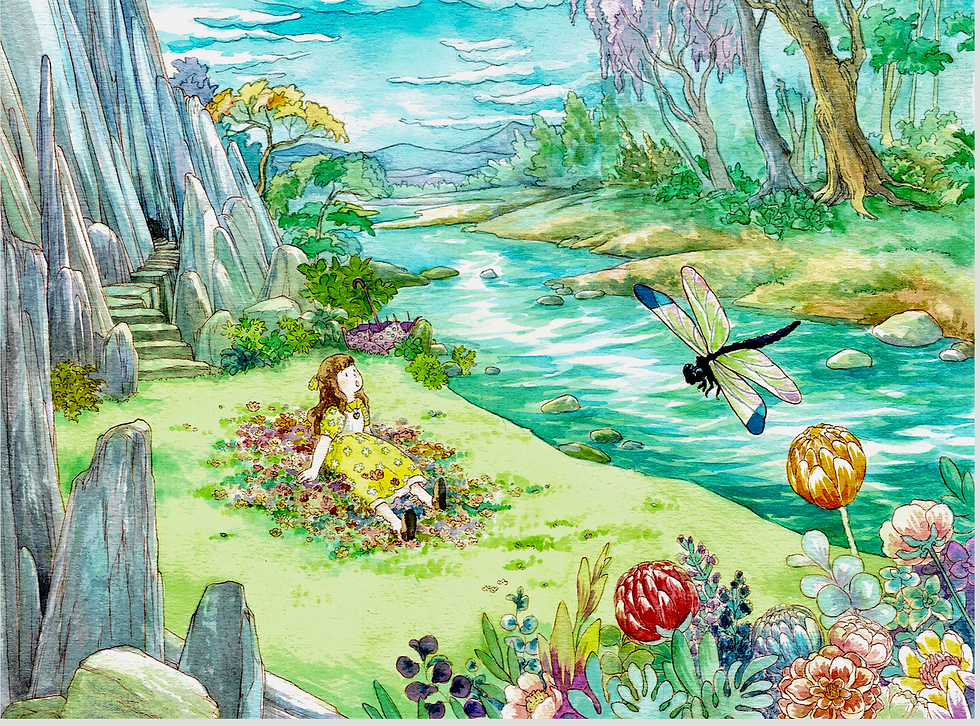
This is the tension in Sparkle Valley. How to stay fully alive while still being connected to reality.
Adaptation and Imbalance
This metaphor may be stretching it, but it popped into my head, and it gets at a part of balance that should be discussed—adaptation. I remember a few years ago when I was a runner and I had some knee pain. I treated the pain as the problem. I stretched, iced, and tried to fight through it.
But eventually, I realized that the pain was the symptom, and I had to attack the core problem. It turned out the problem was actually an imbalance. An imbalance between my quads and my hamstrings. Over time my body had adapted and started compensating around it and I needed to strengthen the muscle group that I’d been ignoring.
What this example shows is the human tendency to adapt. I functioned with this imbalance for a long time. You can overwork or overthink or over control. You can also over escape, getting so involved in creative work that you lose track of your life. And for a while, everything seems to be ok. But then something deeper starts hurting.
The Seduction of Extremes
That's why this balance is harder than it seems. Because both extremes offer something that's seductive. Hank and Frank both have their appeal. Magic. Safety. But too much of one and you get chaos and too much of the other and the soul gets suffocated.
Eventually, Emily realizes that growing up means holding onto imagination and reality together without destroying either one. And that's the balance in Blue Flower Power.
It's emotional wholeness. It's the ability to experience wonder, grief, love, transcendence and responsibility without emotionally shutting down or floating away completely.
Carl Jung wrote about this:

“The creative individual is one who can balance the rational and irrational, the conscious and unconscious, in order to access the full range of human experience.”
And then there’s Nietzsche warning us:
“He who fights with monsters should look to it that he himself does not become a monster.”
Don’t push too long or too far in one direction or the thing you were pursuing will consume you.
Think about the imbalance in modern culture. You have algorithms pushing toward outrage, productivity culture pushing you to burnout. Escapism pushing to withdrawal. None of these routes leads to any kind of wholeness.
And that's probably why the Romantics turned to nature.
Because nature embodies this tension naturally. You see the growth and then the decay. There's chaos within structure.

Wordsworth wrote:
“Come forth into the light of things, let Nature be your teacher.”
And John Muir said:
“Keep close to Nature’s heart.”
Stepping into nature, away from all the noise, recalibrates us. It reminds us that human beings were not meant to exist permanently at one emotional frequency. Life is spiky.
There are moments of heartbreak, wonder, exhaustion, transcendence, grief, beauty, confusion, joy.
The goal isn’t to flatten this out or moderate or “balance” it into some optimized existence. The goal is to stay open enough to feel them but still live in a real life. Keep things grounded. That’s balance in Blue Flower Power.
Blue Flower Power in four ideas
Imagination: See what isn’t there yet.
Joy: Feel deeply.
Courage: Step into life.
Balance: Stay whole.
Continue Exploring
If you want to see this tension in the story
→ Hank & Frank— control versus chaos
→ Abigail’s Impossible Choice — holding both worlds together
→ Emily — learning to grow without going numb
If you want the philosophical roots
→ The Blue Flower — longing and wonder
→ Searching for the Blue Flower — the quest
→ What is Sparkle Valley Philosophy? — the bigger worldview
If you want more practical Blue Flower Power
→ Blue Flower Power: Imagination— seeing what isn’t there yet
→ Blue Flower Power: Joy— staying emotionally alive
→ 5 Ways to Tap into Blue Flower Power — practical ways to reconnect
Blue Flower Power: Quick Reference
For Balance
Core idea: emotional wholeness
What it is not: emotional neutrality, optimization, or “everything in moderation”
Modern threat: burnout, distraction, outrage loops, escapism, emotional flattening
Sparkle Valley expression: Frank and Hank as opposing extremes—chaos and control
Philosophical lineage: Jung, Nietzsche, Wordsworth, John Muir, Romanticism
Guiding line: Stay whole.


